
How to Write Sales Copy That Actually Converts


Sales copy is text designed to persuade readers to take action, like buying your product, joining your list, or downloading something. To write high-converting sales copy, you need to map your customers' exact words, structure your message around one focal point, lead with transformation instead of features, and guide readers to a clear next step.
What Makes Sales Copy Convert
You want people to see your sales copy and feel motivated enough to reach for their wallets. In reality, most copy falls flat because it sounds generic or focuses on details customers don’t actually care about.
High-converting sales copy avoids that trap by using specific elements that grab attention and speak to what people are already thinking: a hook that stops the scroll, emotional language that reflects their real experiences, benefit-focused messaging, objection-busting statements, and a call to action that feels natural and convincing.
Here’s what you need to make sure these elements work together so your copy feels clear and relevant:
1. A headline that neutralizes objections upfront
Your headline is the first thing readers see, and it decides whether they keep going or click away. A strong headline does more than grab attention; it speaks to the doubts people already have and removes them before they can shut down the conversation.
When someone lands on your page thinking they’re not ready, not qualified, or not the right fit, a headline that addresses that belief immediately pulls them in (“You don’t need X, this is for exactly you”). It shows them they’re in the right place and that you understand the obstacle holding them back. By setting this tone from the start, your headline signals that you are about to solve a problem they have been carrying for a long time, which gives them a reason to stay engaged.
2. An introduction that speaks their pain in their words
Once your headline hooks them, your introduction needs to immediately confirm that you understand exactly what they’re struggling with. This is where you reflect their pain back at them using the same language they use; not polished, not sanitized, just honest and real. Readers should feel like you're quoting their internal dialogue. If they say “I don’t know what my passions are” or “I hate selling myself,” those exact phrases go in your introduction.
When someone sees their frustrations articulated word for word and without judgment, they feel seen instead of sold to. That sense of recognition keeps them reading because they believe you actually get what they’re dealing with. The introduction becomes the bridge between their lived experience and the solution you’re about to present, making it clear that the rest of your message is meant specifically for them.
3. An offer that shows the transformation, not just features
Your offer section is where you reveal the solution, but the key is how you present it. Most people default to listing features because it feels concrete: the number of modules, how many videos are included, which tools customers get. But features don’t sell. Readers only care about what those features do for them and how their life will look once they’ve used your product. This section should paint a vivid before-and-after picture, showing the shift from struggle to success.
Don’t just tell them about worksheets and templates; show them how those tools eliminate confusion and give them clarity. Rather than simply listing coaching calls, explain how those calls give them accountability so they finally stop stalling. Transformation is the product; features are just the delivery method.
How to present your offer as a transformation
- “Instead of fumbling through tough interview questions, you’ll know exactly what to say and how to say it with total confidence.”
- “Instead of taking whatever job offer you get, you'll learn how to negotiate better and spark real competition for your skillset.”
- “Instead of ‘trying harder,’ you’ll break through the psychological blocks that have been holding you back for years.”
Center your offer on the emotional and practical change they want, and readers will stop seeing your product as a cost and start seeing it as a path to the future they’ve been trying to reach.
4. A price positioned after you've sold the value
Price only becomes a problem when the value isn’t clear, and that’s why you should never lead with it. By the time you mention the cost, readers should already be imagining the transformation, feeling the relief of solving their problem, and picturing the version of themselves on the other side. Once they want the result, the price becomes a practical detail instead of a barrier.
When you reveal the price after showing the benefits, readers view it through a different lens. They’re no longer thinking, “Can I afford this?” They're thinking, “This might finally fix what I’ve been struggling with.” If you've walked them through their pain, demonstrated the gap between where they are and where they want to be, and shown how your offer bridges that gap, the price feels logical and even expected.
This is why high-performing sales copy always builds momentum before mentioning cost. By the time you get to pricing, they already understand that investing is the next step toward the transformation they want.
5. A call to action that challenges them to choose
Your call to action should feel like the natural next step, not a pushy demand. By the time readers reach this point, they should already understand the problem, see the transformation, and feel confident your offer can help them. The CTA ties everything together and invites them to make a decision instead of simply asking them to click a button.
The most effective CTAs remind readers what’s at stake and highlight the gap between staying where they are and moving toward the outcome they want. Rather than relying on generic commands like “Buy now,” a strong CTA frames the moment as a turning point. You’re showing them that the only thing standing between them and their transformation is a simple action step.
How to Write Sales Copy That Converts
You know the elements that make sales copy compelling, but understanding the pieces is different from actually putting them together. Most people skip the research and jump straight to writing, which is why their copy feels generic and flat. Follow these steps to build copy from the inside out, grounded in real customer psychology instead of assumptions.
Step 1: Create your Customer Desire Map before writing a single word
Before you start typing sentences or trying to be clever, you need a clear picture of what your customer is thinking and feeling. The Customer Desire Map gives you that clarity. Set a two-minute timer and brain-dump every pain point, frustration, fear, and internal monologue your customers have (“I feel like a failure” or “I’m scared of looking stupid”). Don’t edit as you go; the raw, messy phrases you write down are often the ones that hit hardest in your copy.
Once you’ve listed their problems, reset the timer and do the same for their hopes, goals, and desires (“I want a job I don’t dread” or “I want to make enough money to feel secure”). This shows you the outcome they’re chasing.
Finally, repeat the process with their perceived barriers, the things they believe are holding them back (“I don’t have enough experience” or “I don’t even know where to start”). These three lists form your map. It’s an emotional snapshot of your customer’s life before and after your solution. When you’re done, you’ll be able to see the whole journey laid out in their own words, which makes everything you write sharper and more effective.
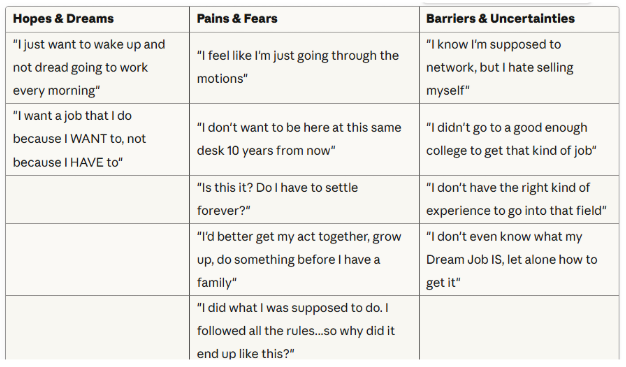
This Customer Desire Map shows you exactly where your customers are right now, where they want to go, and what stands in the way; those three points are the psychological triggers that drive action. Without this map you’re guessing, but with it, the entire direction of your sales copy becomes obvious. The sales page that generated $284,000 came directly from this exercise, which should tell you how powerful it really is.
Step 2: Use their exact words; don't translate or sanitize them
Once you have your Customer Desire Map, it’s time to put their language directly into your copy. Resist the urge to rewrite their words into something “more professional.” Polished marketing language doesn’t convert nearly as well as genuine language pulled straight from your audience’s mouths. If they say “I feel stuck,” then that phrase should appear word for word in your copy, not something sanitized like “experiencing career stagnation.”
People respond to writing that reflects their reality, not writing that sounds like it came from a committee. Check reviews, support emails, conversations, and social posts to get a clear sense of the language patterns your customers rely on. This simple shift makes your copy feel personal, relatable, and honest.
Step 3: Pick one focal point and hammer it home
One of the easiest ways to ruin sales copy is by trying to cover everything your product does. When you try to sell too much at once, you end up selling nothing clearly. Instead, commit to one focus for each piece of copy. Choose a single pain point or a single desired outcome, then build your message around it from start to finish.
If you’re selling a waffle iron to parents, for example, don’t write about how it’s fast and easy to clean and has settings and makes perfect waffles. Pick one: “Sunday mornings with kids mean you’re up at 6 AM whether you like it or not, but the Waffletron 4000 makes breakfast fast so you can actually enjoy family time instead of cooking.”
Focusing on one point creates copy that feels streamlined and intentional. Your reader doesn’t have to work to figure out what matters, and you’re handing them one clear reason to care and reinforcing that message throughout. Whether you’re selling a software platform or a waffle iron, the principle is the same: Focus beats breadth every time.
Step 4: Structure every piece like you're having a conversation
Your copy should never feel like a lecture, but rather read like a natural conversation between you and a person who’s struggling with a real issue. Start by acknowledging their current problem in their language. Then, walk them through why that problem exists, how it affects them, and why the usual solutions haven’t helped. From there, introduce your offer as the bridge that gets them from their frustration to their desired outcome.
When your copy flows like a conversation, it feels easier to read; readers start to trust you because it feels like you get them, not like you’re pitching them. This is why the best sales emails often tell a short story or use simple analogies. They guide the reader toward a moment of clarity and then naturally lead into the next step. The pitch shouldn’t even feel like a pitch at all if you do it well enough.
Step 5: Test and refine based on what actually works
Even strong copy needs refining. You won’t know what resonates most until you put your message in front of real readers. Pay attention to which lines get replies, which sections get skimmed, and which CTAs get clicks; this data is gold because it shows you exactly where you need to tighten your message.
Sometimes emotional language outperforms logical explanations, or sometimes one pain point hits harder than another. The patterns you notice will help you refine your copy for better results every time. Your goal is to double down on what works and remove what doesn’t, not chase perfection at the first attempt.
Four Mistakes That Can Kill Your Sales Copy
Even when you follow the right steps, certain mistakes will tank your conversion rates. Watch out for these common traps that make readers bounce instead of buy.
1. Leading with features before you've sold them on the transformation
One of the fastest ways to lose a reader’s interest is by listing features before you’ve shown them what those features do for them, like “This platform allows you to synchronize data stores in hybrid and multi-cloud environments.”
Nobody in the history of the planet has uttered those words, and features don’t evoke emotion or desire. People only care about the mechanics after they care about the outcome. If you lead with technical details, you’re forcing them to do the work of connecting the dots, and most won’t bother.
Instead, start by painting a clear picture of the transformation your offer provides: “You’ll finally stop fumbling through interviews and land job offers from companies you actually want to work for.” Let them experience the relief, confidence, or success they’ll feel on the other side. Once they want that outcome, they’ll be eager to understand how your features help create it. That is where you demonstrate proof and bolster credibility, but the transformation always comes first.
2. Using corporate jargon instead of writing how humans actually talk
Corporate language makes your copy sound cold and distant. It’s the verbal equivalent of a brick wall between you and your reader. When you use phrases like “enhance operational efficiency” or “facilitate optimal outcomes,” you’re stripping your message of personality and emotional impact. In sales copy, plain and conversational beats polished and technical every time.
A simple test is to read your copy out loud. If it sounds like something you wouldn’t say to a friend, it needs to be rewritten. Real people respond to real language, and your job is to make your reader feel seen, not impress them with vocabulary. If your copy feels human, people lean in, but if it feels corporate, they tune out.
3. Trying to appeal to everyone instead of one specific person
Generic messaging is forgettable; trying to speak to everyone is a sure way of losing the specificity that makes readers feel understood. The strongest sales copy targets one person in one situation with one problem. That clarity allows you to write directly to their internal dialogue and emotions.
Think about the moments that matter most to your audience: The parent trying to squeeze in breakfast before school, the employee staring at the ceiling on Sunday night, or the job seeker sending out applications in frustration. When your copy mirrors a reader’s lived experience, they feel like you wrote it just for them. That connection is what drives action and makes it convert.
4. Creating walls of text nobody will actually read
Even the best ideas fall flat if your formatting makes them hard to consume. Dense paragraphs with no breaks overwhelm readers and cause them to give up before they even reach your main point. Most people skim first and read later, so your layout needs to support scanning.
Use short paragraphs, strong subheadings, and strategic emphasis to guide the eye. Let your formatting highlight your key points so readers can pick them up instantly; high-converting sales pages rely on white space, clear sections, and easy-to-digest chunks for a reason. You’re writing for attention, not just comprehension.
Start Writing (And Stop Overthinking It)
Writing sales copy will always feel a little uncomfortable at first. You’ll second-guess your tone, your phrases, and your structure (and that’s normal). What matters is that you now have a full framework to follow: Map your customer’s desires, use their exact language, focus on one message, write conversationally, and refine through testing.
Your early drafts may feel clunky, but each version will teach you something valuable. Every piece of copy you shape helps you understand your audience better, and the more you write, the easier it becomes to spot the lines that resonate and the ones that need revision.
Progress comes from action, not perfection, so stop waiting for inspiration and start writing. Publish, test, learn, and adjust. The only way to get good at sales copy is to write it, send it, and improve it. Every iteration brings you closer to copy that converts with confidence.
Stay in the know
Be the first one to receive new releases,
special offers, and more